Africa’s artificial intelligence startup ecosystem is growing again.
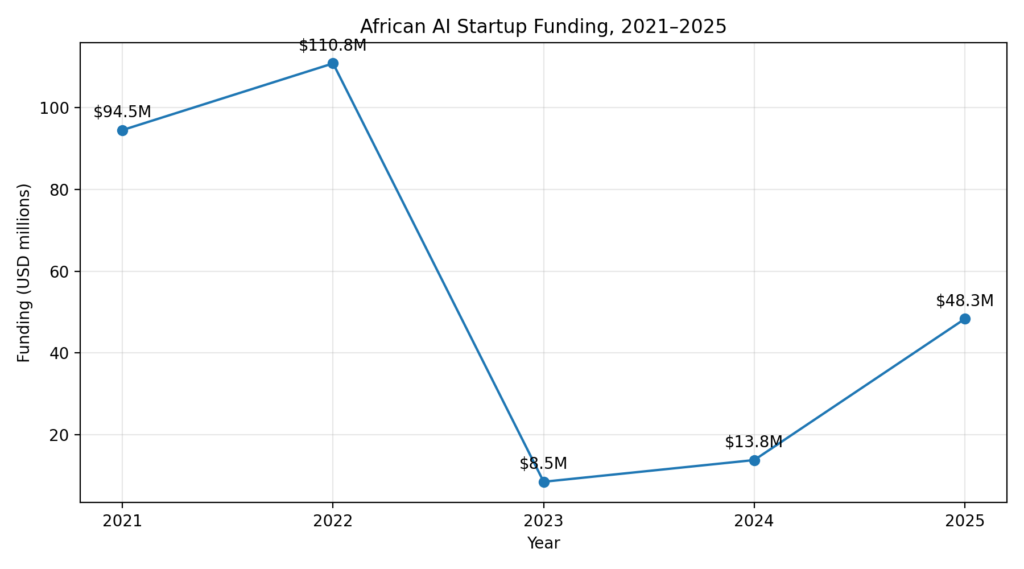
In 2025, African AI startups raised $48.3 million, more than three times the $13.8 million raised in 2024. The number of funded AI startups also increased from nine to 16, according to Disrupt Africa’s African Tech Startups Funding Report 2025.
At first glance, the numbers look like the beginning of an African AI boom.
But there is a problem with that interpretation.
The $48.3 million raised in 2025 was still less than half of the $110.8 million raised by African AI startups at the 2022 peak. And, more importantly, the money was concentrated in a handful of countries.
South Africa alone accounted for almost half of all African AI startup funding in 2025.
The story, therefore, is not simply that African AI funding is returning. It is that Africa is building a larger AI startup ecosystem while investment remains concentrated around a relatively small group of markets.
From collapse to recovery
The trajectory of African AI funding over the last five years resembles a roller coaster.
Funding reached approximately $94.5 million in 2021 and peaked at $110.8 million in 2022. It then collapsed to just $8.5 million in 2023 before recovering to $13.8 million in 2024.
In 2025, funding jumped to $48.3 million.
That represents a 250% increase in one year and roughly a 469% increase from the 2023 low.
But the historical comparison matters.
2025 funding was still approximately 56% below the 2022 peak.
This makes 2025 less of a return to the previous boom than a significant recovery from the funding downturn that followed it.
The distinction matters because a growing funding number does not necessarily mean that African AI startups have suddenly reached a new level of maturity. Most of the funded companies are still young.
Disrupt Africa found that 80% of AI funding rounds in 2025 were at the pre-seed or seed stage.
Africa is therefore not yet witnessing an explosion of mature, late-stage AI companies. It is building an increasingly active pipeline of early-stage companies.
The ecosystem is growing faster than the money
Funding is only one way to measure an ecosystem.
TechCabal Insights identified 207 African AI startups across 17 countries in its 2025 research, compared with 104 companies in its 2022 dataset.
That is almost a doubling of the number of companies being tracked.
The implication is important: the African AI ecosystem is expanding even though the amount of capital available to it remains relatively limited.
This creates an interesting mismatch.
More entrepreneurs are building AI companies. More businesses are experimenting with AI. More investors are returning to the sector.
But the capital required to take these companies from early experiments to regional and global scale is still concentrated.
The next stage of Africa’s AI story may therefore depend less on whether entrepreneurs can build AI startups and more on whether those startups can attract enough capital, customers and infrastructure to scale.
Follow the money
The geographical distribution of 2025 funding makes the concentration particularly clear.
South African AI startups raised approximately $22.8 million, representing 47.2% of the continent’s AI funding.
Egypt followed with $12.5 million, while Tunisia attracted $9.6 million.
Together, those three countries accounted for roughly 93% of the AI funding recorded by Disrupt Africa in 2025.
Nigeria, despite having one of Africa’s largest technology ecosystems, accounted for approximately $2.1 million, or 4.3%.
Morocco received $1.2 million, while Cameroon accounted for about $100,000.
This does not necessarily mean that South Africa, Egypt and Tunisia have the only promising AI companies on the continent. Funding data measures where investment was made, not where all innovation is happening.
But it does reveal where investors are currently willing to place significant amounts of capital.
And that concentration raises another question: what advantages are attracting capital to these markets?
Infrastructure, established technology ecosystems, access to talent, research capacity, investor networks and the ability to serve large or international markets can all influence where capital flows.
For countries outside the leading funding destinations, building an AI ecosystem may therefore require more than producing technically capable founders. They also need the infrastructure and institutions that allow companies to become investable at scale.
Africa does not need to build the next ChatGPT
There is another reason the funding numbers should not be interpreted simply as evidence that Africa is falling behind.
The continent does not necessarily need to compete with OpenAI, Google or Anthropic by training the world’s largest foundation model.
The more immediate opportunity may be applied AI built around African problems and markets.
Healthcare, agriculture, financial services, logistics, education, government services and enterprise software all generate problems where AI can potentially create economic value without requiring a company to train a frontier model from scratch.
This distinction is important.
A startup that builds an AI system capable of helping farmers make better production decisions may create enormous local value without ever developing a model comparable in size to a global frontier model.
Likewise, a company developing AI tools for African financial institutions, medical facilities or businesses can build a defensible business by combining models with proprietary workflows, customer relationships and local data.
The competitive advantage may therefore lie not in having the largest model, but in having the best application of AI to a particular African market.
Data could become the competitive advantage
One of Africa’s most interesting AI opportunities is also one of its biggest unresolved challenges: data.
AI systems depend heavily on high-quality data, yet many African datasets remain fragmented, under-digitised, poorly labelled or difficult to access.
The problem becomes even more obvious in language.
Africa is home to thousands of languages, but many remain significantly underrepresented in mainstream AI systems.
Projects such as Masakhane are attempting to change this by developing datasets and language technologies for African languages. In 2025, Google.org announced $3 million in support for the Masakhane African Languages AI Hub, which works across more than 40 African languages.
This points toward a potentially important form of African AI infrastructure.
Instead of simply consuming models developed elsewhere, African researchers and companies can build local datasets, evaluation benchmarks, language models and domain-specific systems that reflect African environments.
That could become a competitive advantage rather than merely a response to technological exclusion.
The infrastructure problem remains
There is, however, a fundamental limitation.
AI requires more than data and algorithms. It requires computing power, reliable connectivity, electricity, cloud infrastructure and technical talent.
Africa currently has a small share of global computing capacity. The African Union has also identified infrastructure, talent, datasets, investment and governance as critical components of the continent’s AI development.
The infrastructure gap means that even technically strong startups can face high costs when training or deploying computationally intensive systems.
This creates another concentration effect.
Countries with stronger data-centre ecosystems, connectivity and access to capital can become easier places to build AI companies.
The result could be a feedback loop:
better infrastructure → more startups → more investment → more talent → better infrastructure.
Countries that fail to enter that loop risk being left further behind.
The talent question
Capital and infrastructure are only part of the equation.
Africa also needs people capable of building and deploying these systems.
JICA has estimated that Africans account for only around 1% of the global AI talent pool, highlighting the scale of the continent’s human-capital challenge.
But the talent question is more complicated than simply producing more machine-learning engineers.
AI companies need researchers, data engineers, software engineers, product managers, domain experts, cybersecurity specialists, technical writers, policy specialists and entrepreneurs who understand both technology and the problems they are trying to solve.
For Africa, the most valuable talent may therefore be people who can connect AI with specific industries.
A machine-learning engineer who understands agriculture, for example, may be more commercially valuable to an agricultural AI startup than someone who understands machine learning alone.
What investors should watch next
The next phase of African AI investment should not be judged solely by how much money startups raise.
Three indicators may be more revealing.
First, geographic diversification.
If AI investment remains concentrated in three or four countries, the continental ecosystem will remain uneven. A broader distribution of capital would suggest that AI entrepreneurship is becoming viable across more African markets.
Second, movement beyond seed funding.
The fact that most 2025 rounds were pre-seed or seed indicates that the ecosystem is still young. The real test will be whether today’s startups can raise Series A, Series B and later-stage capital while demonstrating sustainable revenue.
Third, commercial adoption.
A startup raising money is not the same thing as a startup creating economic value.
The strongest African AI companies will ultimately need to demonstrate that their products solve expensive problems, retain customers and generate revenue.
That is where the distinction between an AI demonstration and an AI business becomes important.
The opportunity is bigger than the funding numbers
Africa’s AI startup ecosystem is clearly moving again.
Funding increased sharply in 2025. The number of AI startups has expanded. Investors are returning to the sector, while governments and international organisations are increasingly treating AI as a strategic technology.
But the numbers also reveal a more complicated reality.
The continent’s AI funding remains small compared with global AI investment. Most funded startups are still early-stage. And almost all of the funding recorded in 2025 went to a handful of countries.
That means Africa’s AI opportunity cannot be measured simply by asking how much money the continent raised.
The more important question is what happens next.
Can African startups convert early-stage capital into sustainable businesses?
Can governments and private companies build the infrastructure required to deploy AI at scale?
Can African researchers and entrepreneurs turn local data and languages into technological assets?
And can countries outside today’s leading AI markets develop ecosystems capable of attracting serious investment?
The answers will determine whether 2025 was merely a funding recovery or the beginning of a more durable African AI industry.
For now, the evidence suggests that the startup pipeline is growing.
The next challenge is turning that pipeline into scale.